From campus networks to Nanoboxes
In the interview, Dr. Karsten Schörner and Kim Schindhelm from Siemens provide insights into the ECO:DIGIT research project. They explain how it makes the environmental impact of distributed software measurable, the role of cloud and edge computing—including 5G campus networks and Siemens Nanoboxes—and the insights companies can gain for sustainable software development.
Siemens, as one of the five consortium partners, plays a central role in the development and implementation of measurement methods for accurately capturing energy and resource consumption in edge computing environments and mobile networks, particularly 5G campus networks.
Dr. Karsten Schörner leads Siemens’ project activities and is the main point of contact. Together with his team, he develops performance profiling for software and models energy consumption, particularly for containerized edge software. Kim Schindhelm is a research scientist in wireless technologies at Siemens Foundational Technologies. In the ECO:DIGIT project, she investigates the sustainability of 5G campus networks and is responsible for integrating and validating the methodology in the testbed.
At the outset: Digital technologies are seen as key to a sustainable transformation, yet they also contribute significantly to resource consumption and CO₂ emissions. What challenges do you currently see in measuring and reducing the environmental impact of digital technologies, and which of these does ECO:DIGIT address?
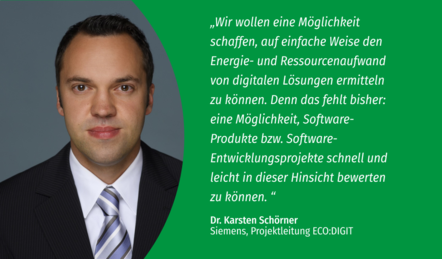
Karsten Schörner: That’s exactly the point: To reduce the environmental impact of digital solutions, we first need to measure or quantify it. Measurement comes before optimization and the resulting reduction in environmental impact. This is exactly where our project comes in: we want to create a way to easily determine the energy and resource requirements of digital solutions. This is currently missing: a way to quickly and easily assess software products and software development projects in this regard.
There are already research approaches and tools, such as the Power API or Microsoft Joulemeter, that measure energy consumption at the software level. Why are these existing approaches insufficient, and how does ECO:DIGIT’s measurement methodology differ?
Karsten Schörner: That’s true; there are already various tools and publications on this topic. Our observation is that the available solutions often only look at energy consumption during the usage phase, neglecting other lifecycle stages. Or a measurement may only cover CPU usage, not the entire system. ECO:DIGIT takes a holistic approach by considering the entire lifecycle, from development to end-of-life and disposal of hardware. Ease of use and broad accessibility are also important so that the methodology can be applied early in software development. These are all aspects we address in the project.
Siemens is responsible in ECO:DIGIT for the measurement methods for mobile networks and edge computing. Can you briefly outline what these areas cover and how your work contributes to the overall project goals?
Kim Schindhelm: Regarding the "Mobile Networks" measurement: we focus on a specific type of mobile network. Mobile networks differ from conventional network types like Ethernet or WLAN. While Ethernet provides a wired, highly stable point-to-point connection and WLAN offers wireless connections over shorter distances, mobile networks such as 5G operate over licensed frequencies, in a cell-based manner, with high user mobility and long range. In such networks, the radio access network (RAN) is especially important—not only for connectivity but also in terms of energy consumption, which is typically highest in the RAN. We focus on 5G campus networks because we have our own 5G campus network components, which allows us to model realistic environments and validate theoretical models with practical measurements. This helps assess the environmental impact of software under realistic mobile network conditions.
Karsten Schörner: For edge computing, we examine industrial use cases, including both compute hardware and typical software applications. For example, we look at Siemens Edge systems such as the Siemens Nanobox or Microbox, used for factory automation. Environmental Product Declarations (EPDs) have been developed for this hardware, considering environmental impact across all lifecycle phases and quantifying them in various categories. We use EPD information in our accounting methodology to accurately reflect device-specific characteristics. We also work on energy models, like our colleagues in the network team, to measure, model, and later predict energy consumption of various software applications on these edge devices.
Focusing on the edge computing measurement methodology: How do you approach this, and what are the biggest technical or methodological challenges?
Karsten Schörner: Our approach uses a hardware profiling tool to conduct stress tests per device. We subject the system to various compute loads and measure energy consumption at the power supply, along with other performance metrics. This produces characteristic energy profiles for each device. We aim to use these profiles to predict future, unknown compute loads. Much will depend on how accurately other load scenarios can be predicted from these profiles.
Edge computing promises local processing power, lower latency, and higher data sovereignty. What does this concretely mean for environmental impact?
Karsten Schörner: That’s a very good question. There’s debate about what’s more sustainable: a local edge deployment without long transfer paths, or a cloud-based solution that may require data transfers over long distances. ECO:DIGIT aims to provide tools for estimating environmental impact for different deployment scenarios. In industrial applications, technical constraints sometimes require local processing. For example, low latency is critical for robotics, which need rapid feedback.
Ms. Schindhelm, your team analyzes the resource and energy demand of mobile networks under real-world conditions. What exactly do you measure, and how can network consumption be assigned to a specific software process?
Kim Schindhelm: We analyze the energy demand of 5G campus networks by capturing network traffic generated by software applications and deriving network load. We use established packet analysis tools to understand application communication patterns, such as packet size, direction (send/receive), and frequency. Assigning energy consumption to a specific process is methodologically challenging. Retrospectively, after execution, consumption can be estimated from recorded traffic. Proactively, beforehand, it’s more difficult, as modern radio networks have adaptive energy-saving mechanisms that adjust based on overall load and user distribution. Our approach uses analytical models that can flexibly simulate different scenarios, providing a solid basis for energy assessment even if exact real-time attribution is not always possible.
Mobile networks have many layers. How do you integrate these complex infrastructures into your measurements, and what are the challenges?
Kim Schindhelm: Mobile networks are multi-layered, from the radio access side to virtualized network functions and core architecture. We take an analytical approach based on concrete use cases that can be integrated into controllable environments like campus networks. Public networks often have dynamically scaling architectures modeled by operators, which would need to be measured for validation. We focus on the components used in 5G campus networks.
The ECO:DIGIT testbed aims to help companies make more sustainable decisions in system and software development—even for edge deployments or connected applications. What needs to happen for the testbed to become integrated into products and business processes, not just remain a research outcome?
Karsten Schörner: At least two things: First, the technical solution must provide real value, i.e., it must be easy to use and give reliable predictions of energy and environmental impact. Second, the software community—developers, product teams, data center operators—must see a need for it, for example via regulations that drive adoption and further development.
ECO:DIGIT is now entering its final year. If you had an additional year and budget, what component would you add, and what topics should follow-up projects address?
Karsten Schörner: I would add GPU assessment. In ECO:DIGIT, we focus on the four basic digital resources: compute, memory, storage, and transfer, with compute limited to CPUs. Including GPUs would make sense, especially with the growing use of AI.
Finally, looking ahead: What would need to happen in the next five years for you to say that ECO:DIGIT has made a real contribution to sustainable digitization? What do you hope for digital infrastructure in 2030?
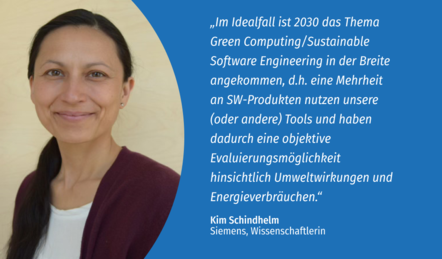
Kim Schindhelm: Ideally, by 2030, Green Computing and Sustainable Software Engineering will be widely adopted, meaning a majority of software products use our (or other) tools to objectively evaluate environmental impact and energy consumption. If our tools are used, even better! This should trigger optimizations in coding, deployment, and hardware selection. The EU requires digital product passports by 2030; perhaps similar requirements for software will follow. ECO:DIGIT could provide a solution to make environmental impact transparent and comparable.
Interview conducted by Teresa Zeck.