Standardisation as Driver for Sustainable Software
How do you measure the ecological footprint of AI? How can digital services be designed to save resources? In the ECO:DIGIT project, we are developing standards to make sustainability in IT measurable and comparable.
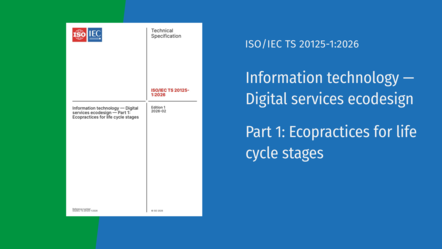
As part of the ECO:DIGIT project, we actively participated in national and international standardization efforts. This included contributing to the development of the ISO standard “EcoDesign of Digital Services”, published in March 2026: ISO EcoDesign of Digital Services.
Additionally, we are involved in the DIN Working Committee NA 043-01-08 AA, “Resource-Efficient Software and Artificial Intelligence”. Here, we collaborate with experts from industry, civil society, and academia to define metrics and methods for measuring and comparing the resource efficiency of software and AI systems across their entire lifecycle.
Why does standardization matter?
Standardization provides the foundation to make sustainability in the digital world measurable and comparable. Only through uniform methods and clear criteria can progress be transparently demonstrated and trust in the results be established. Without such standards, sustainability risks remaining a niche effort. With them, it becomes a shared responsibility and a competitive advantage. At the same time, standardized approaches reduce costs, mitigate risks, and drive innovation, enabling sustainable practices to scale effectively.
Get Involved
Standardization thrives on active participation.
- Learn about opportunities to engage in standardization bodies such as DIN or ISO: More information.
- For direct involvement in the Working Committee, please contact Amelie Buss.