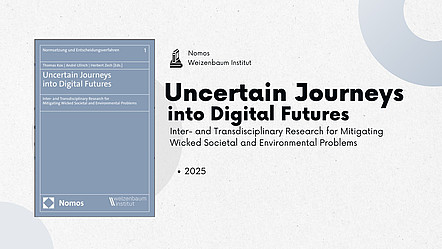
Publication of the Weizenbaum Institute: Focus on sustainable software development
ECO:DIGIT contributes to the publication “Uncertain Journeys into Digital Futures”. The chapter “Green Coding - Bridging the Gap from Theory to Practice” emphasizes the importance of integrating sustainability into software design.
The Weizenbaum Institute's publication entitled “Untertain Journeys into Digital Futures - Inter- and Transdisciplinary Research for Mitigating Wicked Societal and Environmental Problems” was recently published by Nomos Verlag. This interdisciplinary collection is dedicated to urgent social and environmental challenges in the course of advancing digitalization and presents solutions from a variety of research disciplines.
The ECO:DIGIT project is delighted to have made a contribution to this publication: In the chapter “Green Coding - Bridging the Gap from Theory to Practice”, which was published in collaboration with Prof. Dr. Grischa Beier (RIFS) and Prof. Dr. Verena Majuntke (HTW), the focus is on sustainable software development. It examines the influence of software on the energy and resource consumption of hardware. It highlights the growing ecological impact of digital technologies: data centers will already consume around 1.0 to 1.5% of global electricity in 2022, and emissions from information and communication technologies are estimated to account for around 1.5 to 4% of global greenhouse gas emissions.
However, despite a growing awareness of sustainable IT practices, little consideration is often given to sustainable software development. In addition, efficiency gains from new technologies are often used to transfer larger amounts of data instead of making existing data transfers more resource-efficient - a phenomenon known as the “Jevons Paradox”.
To address these challenges, the authors identify several key fields of action:
- The development of standardized measurement methods for the energy consumption of software
- The promotion of sustainable developments through open source initiatives
- The integration of sustainability goals into corporate strategies
- The creation of a political framework to regulate and promote sustainable software development
The authors make a strong appeal for greater consideration of sustainability in the software development process. Because: “All hardware and software have unavoidable resource requirements, and as long as they have an environmental footprint, their use must be carefully considered.” A conscious design of software can make a significant contribution to reducing the ecological footprint of digital technologies and shaping a resource-saving digital future.
Link to the publication: https://www.nomos-elibrary.de/de/10.5771/9783748947585/uncertain-journeys-into-digital-futures