Recording of the presentation: How can I carry out a life cycle assessment on an edge device?
Sustainable digitalisation is about more than just saving energy. A presentation by our project at Green ICT Connect 2025 will demonstrate how to measure and reduce the environmental footprint of edge devices, using a concrete example and offering practical recommendations for action.
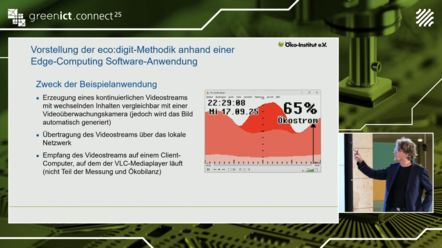
Our colleagues Dr Dirk Bunke and Jens Gröger from the Öko-Institut provided a clear answer to the question of how to conduct a life cycle assessment of edge devices at Green ICT Connect 2025. Green ICT Connect is an annual conference dedicated to resource conservation in information and communication technology (ICT). In their presentation, using the example of a Raspberry Pi in an aluminium casing, they demonstrated how the environmental impact of digital systems can be precisely assessed.
As part of our project, they developed a methodology that uses digital baseline resources to accurately attribute resource consumption to individual software applications. A particular focus was placed on toxicity: a toxin indicator calculates the pollutants released during manufacture, operation and power consumption. Concrete figures demonstrate the potential: a 140 g Raspberry Pi generates approximately 140 g of metal equivalents (MG). This figure can be significantly reduced through the use of recycled aluminium or halogen-free flame retardants.
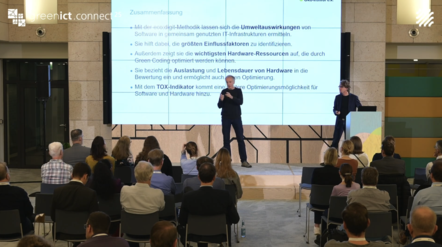
The conclusion is clear: sustainable digitalisation can only be achieved through resource-efficient hardware design and efficient software, and thus through an ecologically optimised approach to the manufacture and operation of entire ICT systems.
Watch the video recording of the presentation